Patricio González Vivo (b. 1982, Buenos Aires) is a multidisciplinary artist with a research-driven practice that explores the edges of core human experiences such as memory, awareness, and self-expression. By combining expressive mediums, both analog and digital, his work attempts to bridge languages and ways of knowing.
His two main mediums are shader code and oil paint. Shader code is a computational language for programming the behavior of light and physics, letting him build real-time simulations that keep changing and responding as someone interacts with them. Oil paint, by contrast, is an old and demanding medium that has given generations of artists an expressive range nothing else has matched.
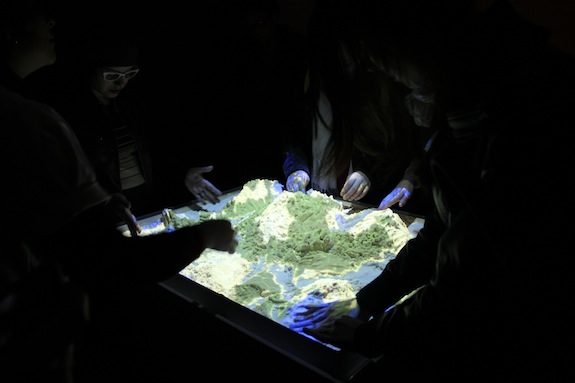
Originally trained in clinical psychology and arts therapy, his early interactive installations in Buenos Aires explored how collective gestures create shared meaning. That work led to his first international exhibition, at FILE Festival São Paulo, and to an MFA at Parsons School of Design in New York, where his thesis introduced him to the drawing machines that anchor his practice today: custom plotters that translate perception into material trace.
Alongside his studio work, an ongoing commitment to open pedagogy led him to author the Book of Shaders, now a foundational resource for learning GLSL and shader programming used by artists and educators worldwide who work with computational art. In addition to his current career as a digital toolmaker, that same commitment has taken him into classrooms at Parsons School of Design's graduate program, ITP NYU, and the School for Poetic Computation, and most recently into mentoring the Processing Foundation's Lead Developer and serving as a dedicated mentor at NEW INC. He has also been invited to give talks for STUDIO for Creative Inquiry at Carnegie Mellon University and Future Sketches at the MIT Media Lab.
His work has been exhibited internationally at Espacio Fundación Telefónica in Buenos Aires, FlyingTokyo in Japan, the Museum of Moving Image in Queens, EYEO in Minneapolis, Resonate in Belgrade, BrightMoments in Buenos Aires, FILE Festival in São Paulo, Rio de Janeiro, and Petrópolis.
2025 Solar Biennale, at Museum of Contemporary Design, Switzerland
2025 NetGala, New York City
2024 Projecto Curatorial Museo Ernesto de la Cárcova, Buenos Aires
2023 Bright Moments
2020 BienalBit
2017 Historia de un malentendido at Espacio Pla, Buenos Aires
2017 Temporal Topologies show at IFP, New York City
2015 +CODE, Buenos Aires
2014 SCOPE Arts Show, New York City
2013 CLOUDS
2013 FILE Festival, Rio de Janeiro
2012 FASE, Buenos Aires
2012 FILE Festival, São Paulo
2012 TEDxTenaris, Buenos Aires