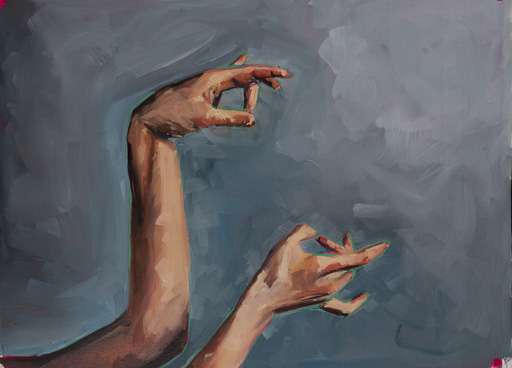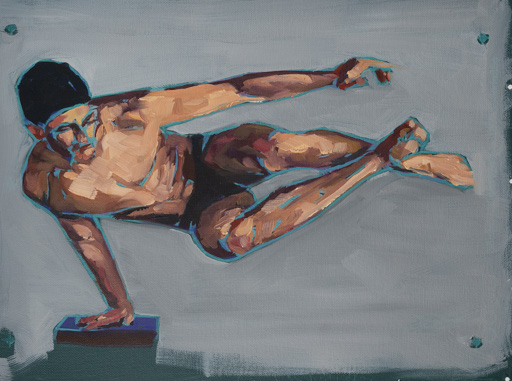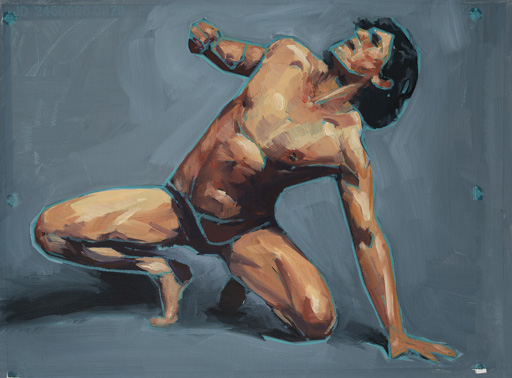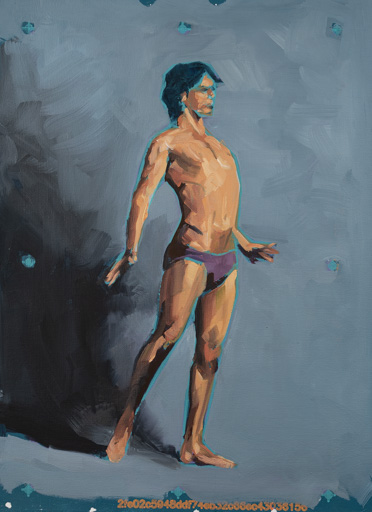
Much of my work, and in many ways myself, emerges from an ongoing act of translation: a movement between disciplines, cultures, and ways of seeing. It all begins with the detection of landmarks and tracing relations. With mapping.
In painting, one learns to locate fixed points: measured intervals of the face, the alignment of features, the geometry that underpins resemblance. These coordinates form a scaffold, an inherited cartography of observation.
Yet, as the process unfolds, this structure gives way. The analytical dissolves into the perceptual: color becomes relational, planes are discerned based on their direction toward lights, and the image begins to breathe beyond its measurements. One departs from the map and enters the sensorial terrain of experience.
At its fullest, this becomes a form of communion. A silent exchange between painter and sitter, where presence supersedes description.
In this series, I shift the burden of mapping onto the machine. By delegating the task of measurement, I allow myself to dwell more fully within the territory of perception.
This practice places the work within a longer lineage of artists who have embraced emerging technologies not as replacements, but as liberating forces: from the optical devices of the Renaissance, to the material innovations of Flemish oil painting, to the portable paint tube that opened the world to Impressionism, etc. Each, reflects a willingness to engage the unknown, to appropiate novel technologies and subvert them to the trascendent job of art making.
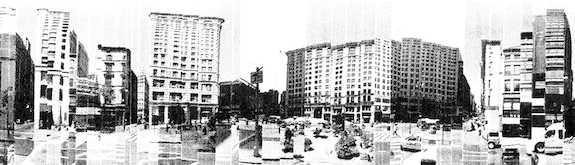
My own exploration with drawing machines began with the construction of a custom wall plotter for Skylines, my MFA thesis at Parsons School of Design in 2014. Since then, I have approached the machine and digital tools as collaborators, artifacts capable of extending my ability to see and create. For this body of work, I developed a bespoke program that employs computer vision to analyze images, translating their latent structures into vector paths that then are drawn by a plotter on to a primed canvas.
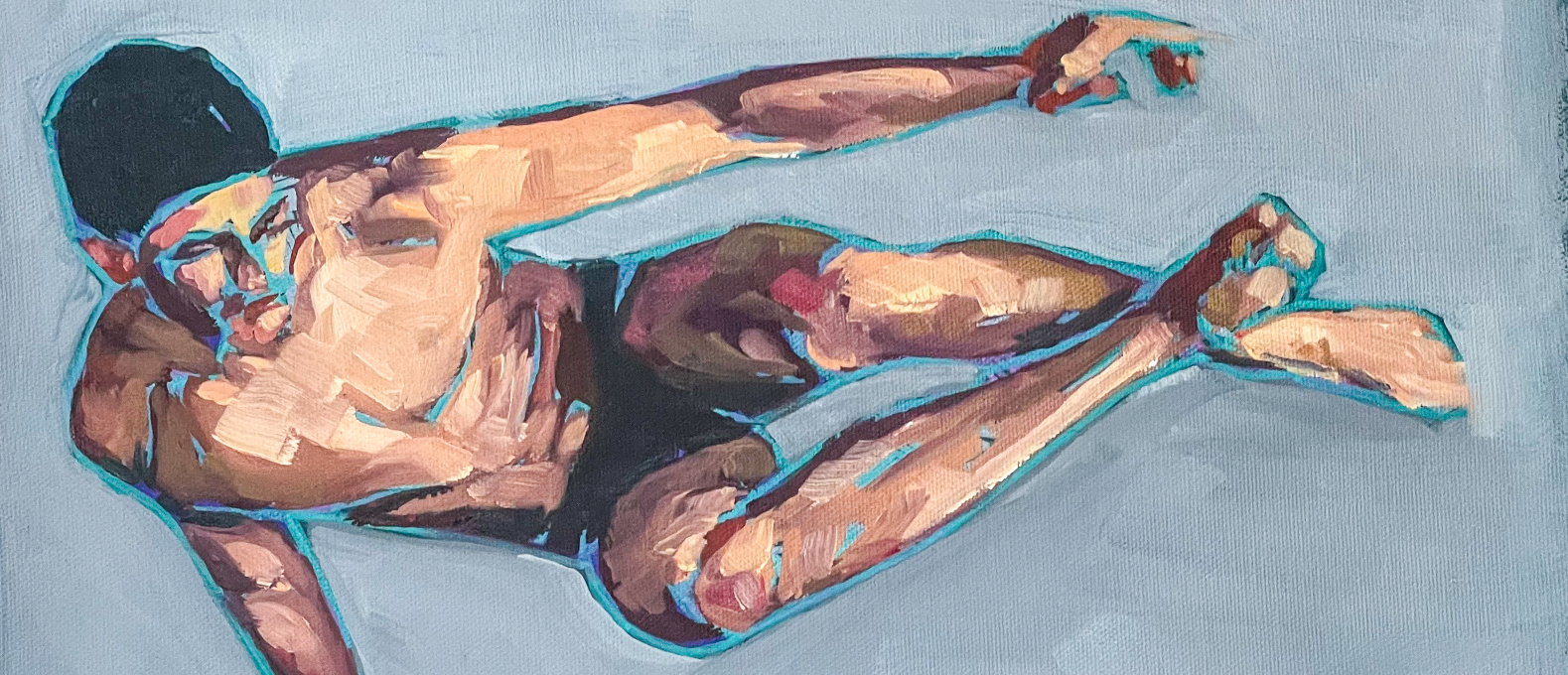
Once this cartography is laid down, I return to it with oils and brushes. Freed from the obligation of precision, I enter the painting as a space to inhabit rather than to describe. The work becomes an arena for subjectivity and exploration. Gestural, intuitive, and responsive.

Because digital information gravitates toward replicability, this method opens a field of iteration. Each variation becomes an opportunity to sharpen, distort, or deepen the singularity of perception. To accentuate the irreducible nature of subjective experience.
The resulting paintings exist as hybrids: part made by a machines, part by my own hands. Yet the authorship remains unified. I am responsible for both: the code and the gestures, both commanded by my singular vision. These works do not seek to replicate reality, but to evoke it through a complementary dialogue between systems, materials, and ways of seeing.